
 033 4084 4084
MPC Cuts Repo Rate by 25 bps; RBI Raises FY26 GDP Growth Forecast to 7.3%
Posted Under Home Buying Tips, GST On 05 January, 2026
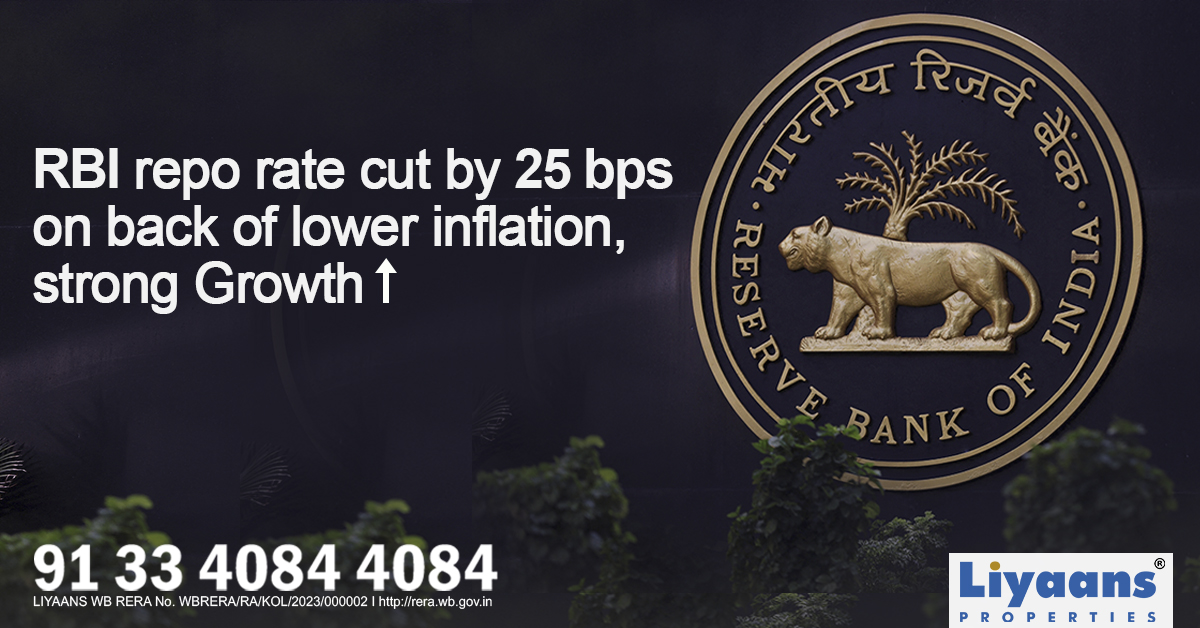
The Reserve Bank of India’s Monetary Policy Committee (MPC) announced a 25 basis-point cut in the repo rate, bringing it down to 5.25% effective immediately. The decision was taken unanimously during the policy meeting held on December 5, 2025.
Why the RBI Cut the Repo Rate
The rate reduction comes as India witnesses two major economic trends:
1. Real GDP growth surged to 8.2% in Q2, reflecting strong economic momentum.
2. Headline inflation dropped sharply to 1.7%, slipping below the RBI’s lower tolerance band of 2% for the first time under the flexible inflation targeting framework.
Since Governor Sanjay Malhotra took office in December 2024, the MPC has now delivered 125 basis points of cumulative cuts over four policy meetings.
Lower repo rates are expected to help reduce borrowing costs, benefiting retail borrowers, corporates, and the wider financial system.
Revised Policy Rates
With the latest cut, the following rates stand adjusted:
1. Standing Deposit Facility (SDF): 5%
2. Marginal Standing Facility (MSF) & Bank Rate: 5.50%
The MPC also retained a neutral stance, indicating that future rate movements will depend on incoming growth and inflation data.
Governor Malhotra’s Explanation: Why the Cut Was Necessary
In his statement, Governor Malhotra highlighted that:
“ Headline inflation has moderated significantly and is likely to remain softer than earlier estimates, mainly due to exceptionally benign food prices.”
He added that underlying inflation pressures remain subdued, even after accounting for the rise in precious metal prices, which contributed around 50 bps.
On growth, he said that although momentum remains strong, some moderation may be visible. The favourable inflation outlook gives the central bank policy space to support economic expansion.
Growth Outlook Strengthened
The RBI raised its FY26 real GDP growth projection to 7.3%, up from the earlier 6.8%. The quarterly forecasts are:
1. Q3 FY26: 7%
2. Q4 FY26: 6.5%
3. Q1 FY27: 6.7%
4. Q2 FY27: 6.8%
The central bank said risks to growth remain evenly balanced.
Economic activity in the first half of the fiscal year benefited from:
1. Income Tax and GST rationalisation
2. Softer crude oil prices
3. Front-loaded government capital expenditure
4. Supportive financial conditions and low inflation
High-frequency indicators for Q3 show resilience, though early signs of weakness appear in some sectors.
CPI Inflation Forecast Reduced
The RBI also sharply revised its CPI inflation forecast for FY26 to 2%, 60 basis points lower than the earlier estimate. The updated quarterly projections are:
1. Q3 FY26: 0.6%
2. Q4 FY26: 2.9%
3. Q1 FY27: 3.9%
4. Q2 FY27: 4%
A “Goldilocks” Phase for the Indian Economy
Governor Malhotra described the current environment as a rare Goldilocks period, where inflation is extremely low and growth remains high.
1. Average inflation in Q2 FY26 fell to 1.7%, breaching the RBI’s lower tolerance limit.
2. October 2025 inflation dropped further to 0.3%.
3. At the same time, GDP growth touched 8.2%, boosted by festive season demand and GST rationalisation.
This combination of high growth + low inflation is considered ideal for stable expansion.
Industry Reaction
C.S. Setty, Chairman of SBI and the Indian Banks’ Association (IBA), welcomed the policy decision. He said:
“The RBI’s December 2025 policy sends a strong message that the Indian economy is on firm ground, with robust growth and comfortably low inflation.”
He added that keeping the door open for further easing can help cushion the economy against external shocks, reinforcing India’s “higher-for-longer” growth outlook driven by strong investment, credit demand, and consumption.
By LNN (Liyaans News Network)
 GST
GST -
 August 2026 (1)
-
July 2026 (5)
-
June 2026 (1)
-
May 2026 (2)
-
April 2026 (1)
-
March 2026 (1)
-
February 2026 (5)
-
January 2026 (3)
-
November 2025 (3)
-
October 2025 (2)
-
September 2025 (1)
-
August 2025 (4)
-
July 2025 (2)
-
June 2025 (4)
-
May 2025 (3)
-
March 2025 (2)
-
February 2025 (5)
-
January 2025 (1)
-
December 2024 (2)
-
November 2024 (1)
-
October 2024 (2)
-
September 2024 (1)
-
August 2024 (1)
-
July 2024 (5)
-
June 2024 (2)
-
May 2024 (6)
-
March 2024 (2)
-
February 2024 (1)
-
January 2024 (3)
-
December 2023 (4)
-
November 2023 (3)
-
October 2023 (4)
-
August 2023 (4)
-
July 2023 (2)
-
June 2023 (4)
-
May 2023 (2)
-
April 2023 (2)
-
March 2023 (2)
-
January 2023 (1)
-
December 2022 (1)
-
November 2022 (1)
-
October 2022 (3)
-
September 2022 (3)
-
August 2022 (4)
-
July 2022 (5)
-
June 2022 (7)
-
May 2022 (2)
-
April 2022 (3)
-
March 2022 (6)
-
February 2022 (2)
-
January 2022 (7)
-
December 2021 (2)
-
November 2021 (4)
-
October 2021 (3)
-
September 2021 (4)
-
August 2021 (3)
-
July 2021 (3)
-
May 2021 (2)
-
April 2021 (1)
-
February 2021 (1)
-
January 2021 (1)
-
November 2020 (1)
-
October 2020 (1)
-
September 2020 (1)
-
August 2020 (3)
-
July 2020 (6)
-
June 2020 (4)
-
May 2020 (5)
-
April 2020 (5)
-
March 2020 (2)
-
February 2020 (3)
-
January 2020 (2)
-
December 2019 (4)
-
November 2019 (3)
-
October 2019 (1)
-
August 2019 (1)
-
July 2019 (1)
-
June 2019 (8)
-
May 2019 (5)
-
February 2019 (1)
-
January 2019 (1)
-
October 2018 (1)
-
September 2018 (1)